Walk me through how you create an expense model for a company
Answer
What you would normally do is break out or lightly group each line item. You would concurrently attempt to get an employee census and forecast using that. Let’s start with the non-employee expenses.
Expense Build:
Let’s use the software company as an example. For the sake of this example, let’s say they have five total non-personnel expenses:
- Hosting Expenses
- Website Maintenance Expenses
- Accounting Fees (assume outside services)
- Rent
- Hosting Expenses
Nowadays, all software companies are on the cloud via AWS / Microsoft Azure. In simple terms, these are the costs it takes to keep the product online. This expense increases as more users are using the product. This means they are considered a cost of goods sold and as a result scale with revenue. So, you would forecast this by holding the cost as a % of revenue constant. So, if hosting costs were 5% of Revenue in the current year, you should hold this as 5% in the forecasted years. See below for a formula:
Next Year’s Hosting Costs = Next Year’s Revenue * (Current Year Hosting Costs / Current Year Revenue)
Irrespective of software or not, Cost of Goods Sold items that are not personnel can be forecasted as a % of total revenue.
Website Maintenance Expenses:
Since these are the expenses to keep the website functioning correctly, they can be considered directly tied to revenue. So we would use the same methodology as above to forecast them.
Accounting Fees
If it’s not obvious yet. 90% of expenses start with the question “Do these scale with revenue?”. So, let’s say that Accounting Fees are just yearly audit costs. Should this scale with Revenue? Well, they’re just doing accounting so conceivably not. Therefore, you should grow this expense as it grew historically. If it grew 5% last year, grow it 5% this year.
Rent
Rent can be tricky. You have a couple of options.
First, if the company tells you that next year they are going to move to a new office and this will cause Rent to increase by $2mm a year, then that’s how much you increase it.
If they don’t, you can either hold it constant (not recommended because it’s not conservative) or keep it as a % of Revenue. Although yes it shouldn’t scale directly with Revenue, you should more or less get it right over the wrong term and you’re more likely to overshoot it then undershoot it.
Wrap-Up
You should end up with something that looks like the below:
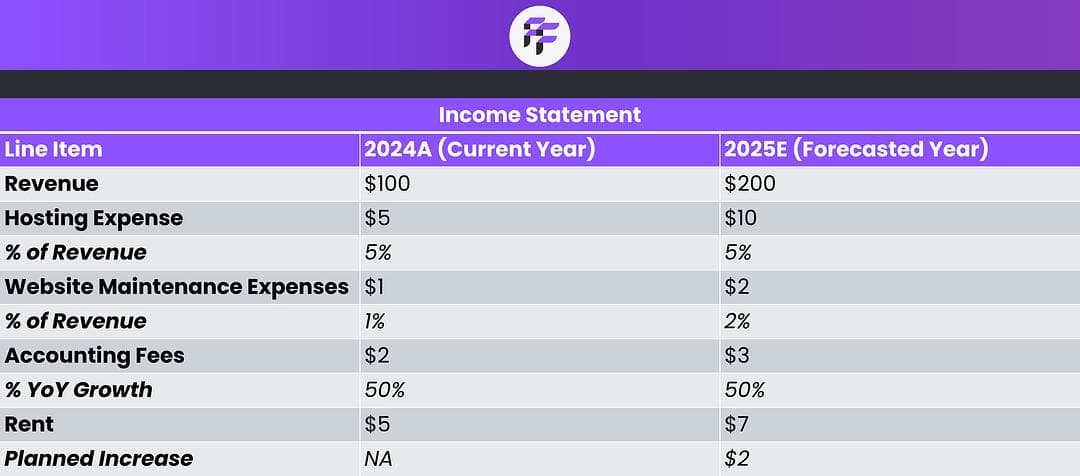
FYI - there is not a chance accounting fees jump 50% in a year lol, just using that for illustrative purposes.
Personnel Build:
This part is a bit more complicated and you can’t walk through it the same way you can the above so I’ll cover the key concepts to stand out a bit. So, an employee census should have all their employees with their role and salary. You want to forecast any raises or terminations along with new hires.
Raise: Let’s say they plan on giving all Junior Developers at 5% raise next year, you simply multiply all of their salaries by 1.05
Terminations: You would turn off an employee next year if they are being terminated (depends time of year but this is enough high-level to get you through)
New Hires: Let’s say that those same Junior Developers above get paid $100k a year. You would add another dev to start hitting when they are planned to be hired at $100k a year.
Overall this is simple contextual information, but a little awkward to build out on excel sometimes. Going into this level of detail and using these examples will create differentiation.
Why this matters to bankers
Given most businesses trade off of EBITDA Multiples, expense models are highly scrutinized by potential acquirers given they are the driver of projected profitability. There are two reasons why. First, buyers want to understand what expenses will or could look like post-transaction due to changes in management or strategy. Second, they want to have a clear picture of how expenses will change as the business grows.